Advocate → Activist
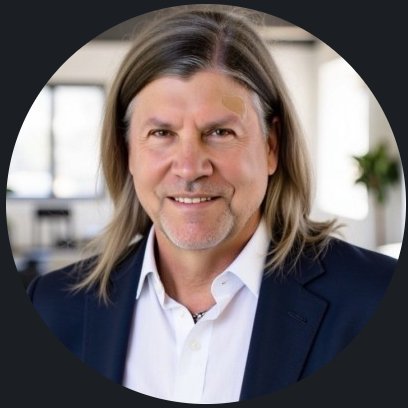
Mike Hawkins has spent three decades in, on, and under the world's oceans — as a rescue diver, adventure athlete, and Prentice Hall technology author. He now leads NeuroSync's North American engagement, moving from advocating for ocean health to building the infrastructure that restores it.
Thirty years of
ocean experience
Rescue diver. International adventure athlete. Author. Speaker. Mike Hawkins has spent his working life in the environments NeuroSync's marine technology is designed to protect.
Originally trained at the University of California, Berkeley, Mike's early career placed him at the intersection of large-scale technology and high-risk operational environments. He is the author of five technology books published by Prentice Hall, covering enterprise infrastructure, availability engineering, and risk — a body of work that continues to be referenced in IT architecture practice today.
His parallel life has been spent in the Pacific. Over three decades he has dived with sharks, survived military coups, been trapped in underwater caves, weathered volcanic eruptions and ocean storms, and built a network that spans the dive, surf, and coastal communities of Hawaii, the Indo-Pacific, and North America's East and West coasts. He is now based just outside Washington, DC.
Mike is the founder of the New, Hard, and Dangerous Things series — a body of writing and speaking that has built a global following around resilience, leadership under pressure, and lived experience. He speaks internationally, writes continuously, and advises organisations operating in high-risk environments.
What he brings to NeuroSync is not credentials on a page. It is standing in the communities that the oceans feed, an engineer's grasp of how large systems really work, and the operational nerve to put both to use.
From advocacy to activism
Three decades of advocacy for ocean environments become something else entirely when married to infrastructure that can act at scale. This is that transition.
Witness
Thirty years in the water. A front-row seat to the degradation of coral reefs, the collapse of fisheries, and the arrival of sargassum inundation on coastlines that never knew it. Advocacy built on what he has seen first-hand.
Systems
Five Prentice Hall technology books. A career architecting systems that have to work when the stakes are high. The discipline required to move from describing a problem to building something that fixes it.
Action
The NeuroSync partnership. Bio-Farm deployment across North America and the Miami-Dade hotel corridor. Taking infrastructure that sequesters carbon, feeds the RAPID family of medical derivatives, and protects marine habitats — and putting it into the water where it matters.
North American
Engagement Lead
Bio-Farm deployment strategy
Identifying, qualifying, and sequencing North American deployment sites for sargassum interception and processing — matched to local feedstock opportunity and regulatory environment.
Miami-Dade hotel corridor
First-line engagement with coastal hospitality operators whose revenue model depends on beach quality, and with the municipal beach services that contract with them. Site consultancy and guaranteed-clean-beach contract structures.
Scientific credibility
Working relationships with academic institutions monitoring sargassum at basin-scale, ensuring NeuroSync deployments are scientifically anchored and independently credible from day one.
US corporate structure
Standing up the North American legal and commercial entity, including appropriate operating structure and compliance for defence-adjacent engagements flowing from Medical Division derivatives.
Marine. Medical. Environmental.
Mike's North American engagement begins with Marine because that is where his expertise and networks are deepest. As the Bio-Farm deployment establishes, the remit expands into the products it enables.
Sargassum interception and carbon sequestration infrastructure
The Bio-Farm system is the anchor deployment. It intercepts sargassum at scale, processes it into nine revenue streams, and in doing so sequesters carbon through three simultaneous pathways. BIO-PRESERVE™ (UK00004361325) supports marine habitat protection alongside it.
Battlefield medical technology derived from marine feedstock
Once Bio-Farm is producing, the RAPID family of medical devices — RAPIDPen, RAPIDPlasma, RAPIDConnect, RAPIDGauze — becomes available to North American defence and medical channels. Mike's US structure enables that conversation.
Three simultaneous carbon pathways from a single deployment
The Environmental division converts Bio-Farm's sequestration performance into verified carbon credits across three concurrent pathways, opening corporate and compliance market channels across North America.
Press and media
Journalists, podcasters, and conference organisers: Mike is available for interviews, keynote engagements, and on-the-record commentary on ocean technology, sargassum inundation, and marine-to-medical value chains. Approved media assets and a full bibliography are available on request.
Selected bibliography
North American enquiries
For enquiries regarding North American Bio-Farm deployment, media requests, speaking engagements, or partnership conversations, use the form opposite. All enquiries are reviewed by NeuroSync's leadership and routed appropriately.
Response within two working days.